Assist Gas Matters as Much as the Laser Itself
At Midnight Industrial, one of the most common questions we get from shops evaluating a new laser isn't just about wattage or bed size — it's about assist gas and how each option performs and applies. It's a fair question: the gas running through the cutting head has as much influence on cut quality, speed, and cost-per-part as the laser source itself.
Assist gas does two jobs during cutting: it clears molten material out of the kerf so the beam can keep cutting cleanly, and it manages heat at the cut edge. Which gas does that job best depends entirely on the material, thickness, and what the finished edge needs to look like. Here's how we walk customers through the five main options.
1. Oxygen
Oxygen is the traditional workhorse for cutting mild and carbon steel. When the beam contacts the metal, oxygen reacts with it in an exothermic reaction that adds its own heat energy to the process, on top of the laser itself.
Advantages:
- Faster cutting speeds on mild steel, especially at greater thicknesses, since the chemical reaction assists the laser rather than working against it
- Lower operating cost than inert gases, since oxygen is inexpensive and readily available
- Effective at cutting thicker mild steel that would otherwise require significantly more laser power
- Provides one of the cleanest finished surfaces of all gases in most applications
Disadvantages:
- Leaves an oxidized, often discolored edge that may need secondary finishing before painting, plating, or welding
- Higher oxygen pressure raises cutting speed but can also increase dross and edge burn if not carefully controlled
- Not well suited to stainless steel or aluminum, where oxidation compromises appearance and corrosion resistance
Best applications: Structural steel, general fabrication, and any mild steel part where edge appearance is secondary to cutting speed and cost — brackets, frames, enclosures, and heavy structural components.
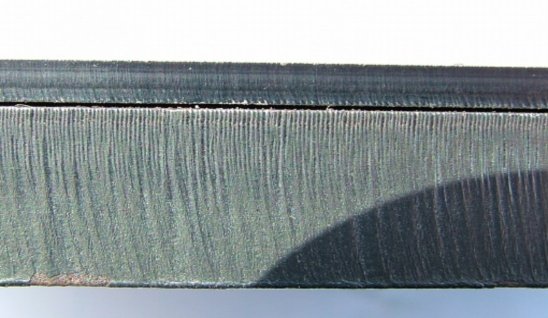
Close-up of an oxygen-cut mild steel edge, showing the characteristic darker, oxidized finish.
2. Nitrogen
Nitrogen is an inert gas — it doesn't chemically react with the material being cut. Instead, it's used at high pressure to physically blow molten material out of the kerf while shielding the cut edge from oxidation.
Advantages:
- Produces a clean, bright, oxide-free edge — often ready for welding, painting, or plating with no secondary finishing
- Low-temperature cutting, which keeps material deformation to a minimum
- The preferred gas for stainless steel and aluminum, where oxidation is a real quality concern
- Consistent, repeatable cut quality across a wide thickness range
Disadvantages:
- Higher operating cost, since nitrogen requires higher pressure and greater gas consumption than oxygen
- Can be slower than oxygen-assisted cutting on thick mild steel, since there's no exothermic reaction helping the process along
- Requires a reliable high-purity nitrogen supply — bottled, bulk tank, or an on-site generator — a real infrastructure investment for high-volume shops
Best applications: Stainless steel and aluminum parts, and any application where a clean, oxide-free edge is required for cosmetic finish, welding prep, or corrosion resistance — enclosures, food-grade equipment, architectural panels, and precision components. Also useful for thin sheet products where deformation needs to be controlled.
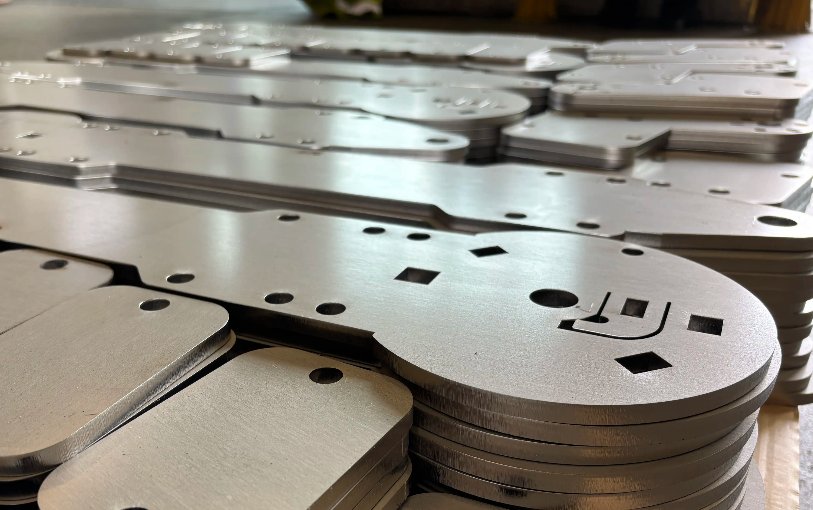
Nitrogen-cut stainless steel edge, showing the bright, oxide-free finish nitrogen is known for.
3. Compressed Air
Compressed air is essentially a low-cost, less-pure substitute for nitrogen — naturally about 78% nitrogen and 21% oxygen, so it behaves as a mildly reactive gas: less aggressive than pure oxygen but not fully inert like nitrogen.
Advantages:
- Lowest operating cost of any assist gas, requiring only a standard compressor designed for laser cutting
- Reasonably fast cutting on thin mild steel, aluminum, and stainless steel
- Simple to integrate into a shop with compressed air infrastructure already in place
Disadvantages:
- Edge quality and consistency fall short of pure nitrogen or oxygen, with some oxidation and variability likely
- Requires proper filtration and drying — untreated air introduces oil and moisture that can contaminate optics and shorten machine life
- Not suitable for reactive materials like titanium or magnesium, and generally a poor choice as material thickness increases
Best applications: Thin-gauge general fabrication where budget matters more than cosmetic edge finish — prototyping, low-cost production runs, and shops without existing nitrogen infrastructure.
4. Mixed Gas
Mixed gas cutting blends oxygen and nitrogen (or adjusts oxygen concentration within a nitrogen stream) to combine the speed benefits of oxygen with more control over edge quality than straight oxygen alone. It's most often used on thicker mild steel, where pure nitrogen would be too slow and pure oxygen would create excessive dross or burn.
Advantages:
- Faster cutting on thicker mild steel than nitrogen alone, while producing a cleaner edge than straight oxygen
- Allows fine-tuning of oxygen concentration to match specific thickness and quality requirements
- A useful middle ground for shops cutting a wide range of steel thicknesses without switching gas systems constantly
Disadvantages:
- Requires more sophisticated gas control and, on some systems, dual-gas delivery hardware
- More complex to dial in correctly than a single-gas setup, with less predictable results absent careful process control
- Not a universal solution — still unsuitable for stainless steel or aluminum where any oxidation is unacceptable
Best applications: Thicker mild steel components where straight oxygen produces unacceptable dross or burn, but pure nitrogen cutting speed is too slow to be economical.
5. Argon
Argon is a fully inert noble gas, even less reactive than nitrogen. It's the least commonly used assist gas in general fabrication, reserved for materials where nitrogen itself isn't inert enough.
Advantages:
- Provides a completely inert cutting atmosphere, with no oxidation risk whatsoever
- The gas of choice for highly reactive metals like titanium, where even nitrogen can react with the material at high temperatures
- Produces the cleanest possible edge on metals sensitive to any atmospheric contamination
Disadvantages:
- The most expensive assist gas by a significant margin, ruling it out for routine production work
- Slower and less commonly optimized in standard machine software compared to oxygen and nitrogen, as a lower-volume use case
- Overkill for standard steel, stainless steel, or aluminum, where nitrogen already achieves excellent results at a fraction of the cost
Best applications: Titanium, palladium, reactive alloys, and aerospace or medical-grade components where absolute freedom from oxidation is a hard requirement, not a preference.
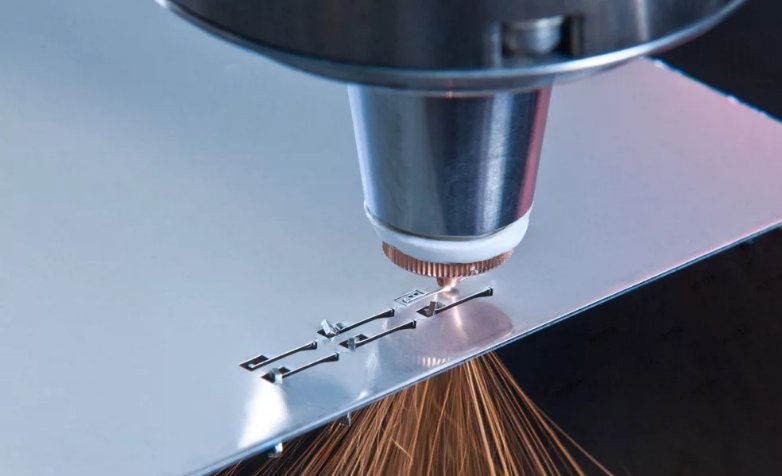
Argon-cut edge, fully free of oxidation thanks to the fully inert cutting atmosphere.
How Midnight Industrial Machines Handle This
Because gas choice varies so much by job, we build our machines with the flexibility to switch between oxygen, nitrogen, air, and mixed-gas cutting without hardware changes — the control software lets operators dial in gas type and pressure per job rather than committing to one setup. For shops that also need argon capability for specialty materials, we can configure gas delivery systems during the build process rather than requiring a retrofit later.
The right assist gas isn't a fixed answer — it's a decision made per part, based on material, thickness, and what the finished edge actually needs to do next. A machine that makes that decision easy to change, job to job, is worth more on the shop floor than one that locks a shop into a single gas setup from day one.
| Gas | Best for | Edge quality | Relative cost |
|---|---|---|---|
| Oxygen | Mild / carbon steel | Clean but oxidized (dark) | Lowest |
| Nitrogen | Stainless steel, aluminum | Bright, oxide-free | High |
| Compressed air | Thin-gauge, budget work | Moderate | Lowest infrastructure cost |
| Mixed gas | Thicker mild steel | Cleaner than oxygen alone | Moderate–high |
| Argon | Titanium, reactive alloys | Fully oxide-free | Highest |
No single assist gas is "best" — each one trades off speed, cost, and edge quality differently, and the right choice depends entirely on the material and the job. Oxygen wins on speed and cost for mild steel. Nitrogen wins on edge quality for stainless and aluminum. Air wins on cost for thin, non-critical work. Mixed gas splits the difference on thicker steel. Argon exists for the narrow set of jobs where nothing else will do. Understanding these tradeoffs — rather than defaulting to whatever gas came with the machine — is what separates efficient cutting operations from expensive guesswork.