Why thick plate stresses the laser system
Beyond 12mm, the beam must sustain enough power density through the full thickness — cutting shifts from surface melting to deep penetration. Any imbalance causes dross, rough striations, or failure to cut through. These three parameters decide success.
1. Laser power & focus position
Power sets the maximum cuttable thickness; focus position sets how energy distributes through the plate. For thick plate, place the focus below the surface so the melt zone concentrates mid-thickness.
- Carbon steel 16mm: 6kW+, focus ≈ −2 to −4mm
- Carbon steel 25mm: 12kW+, focus ≈ −4 to −7mm
- Stainless 20mm (N₂): 15kW+, with high-pressure gas
2. Assist gas & pressure
Thick carbon steel typically uses oxygen (exothermic oxidation adds energy and raises speed); stainless and aluminium use high-pressure nitrogen for an oxide-free bright edge. Poor purity or unstable pressure is a leading cause of dross.
3. Cutting speed & corner accel/decel
Thick plate cuts slowly with high heat input; corners and small arcs must slow to prevent heat build-up and edge collapse. Servo accel/decel quality often matters more than peak speed for real yield.
| Material / thickness | Power | Assist gas |
|---|---|---|
| Carbon steel 12mm | 4–6 kW | Oxygen |
| Carbon steel 25mm | 12–20 kW | Oxygen |
| Stainless 20mm | 15–30 kW | HP Nitrogen |
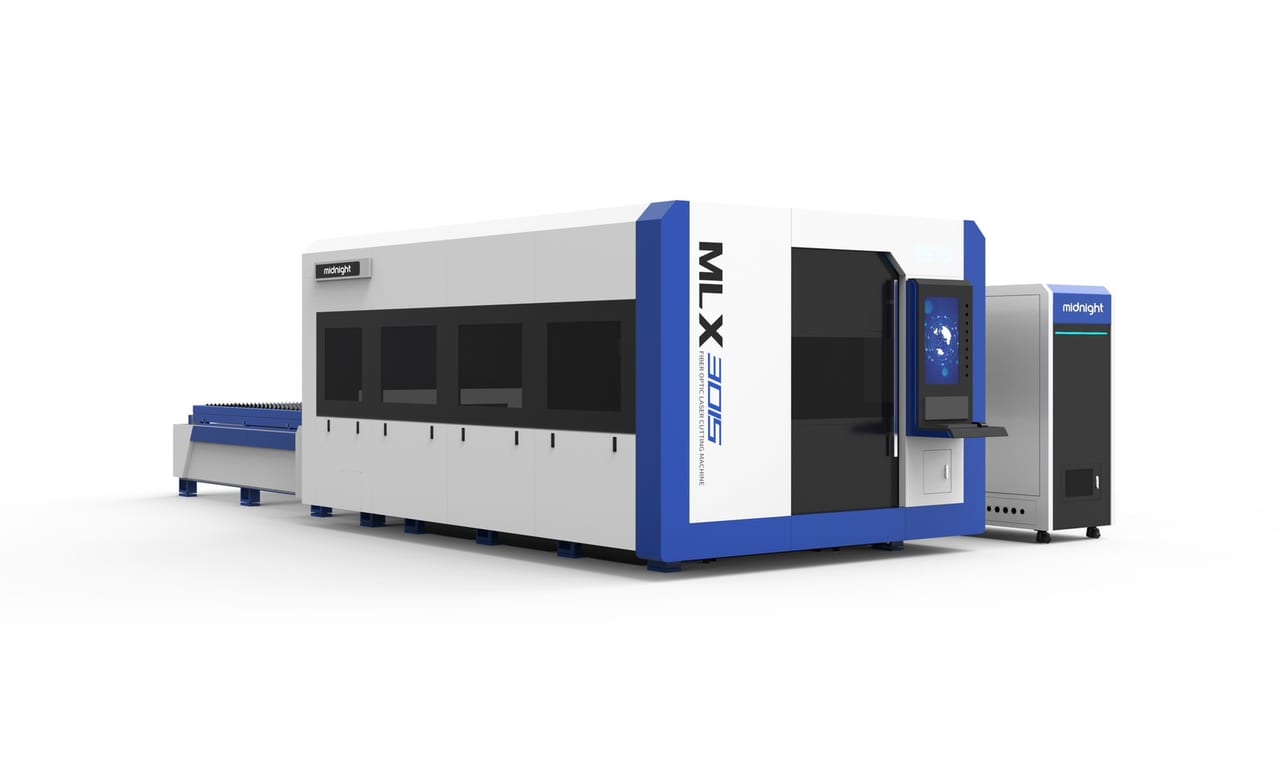
Midnight MLX / MHLX series use in-house AI dynamic path optimization to auto-tune corner speed and piercing on thick plate — balancing yield and throughput.